Showing posts with label Macroeconomics. Show all posts

Aug 31, 2014

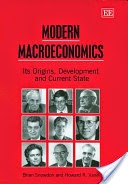
Modern Macroeconomics: Its Origins, Development and Current State

I am rereading the book Modern Macroeconomics: Its Origins, Development and Current State (2005) by Brian Snowdon and Howard R. Vane. 
A few points:
  1. This is one of the first, and few, macroeconomics books that dedicated a chapter to Austrian economics.
  2. More than a macroeconomics textbook, I see it as a history of macroeconomic analysis (in the Schumpeter way). It starts with the classical approach, then with the orthodox Keynesian model, then the IS-LM model for an open economy, monetarism and son on. 
  3. The history of macroeconomics analysis is a history of revolutions and counterrevolutions. There are as well schools of thought that developed parallel to the "mainstream."
  4. There is some chronological overleaping as well, for example the Mundell-Fleming model was developed by the time the monetarism revolution was starting in the early 1960s. 
  5. The history of macroeconomic analysis is fascinating and the book makes it clear that it is an evolving field, and very likely what is in vogue today might well not be discuss in a few years - some current theories will be incorporated into the "mainstream," but not necessarily

Feb 7, 2014

Using NPR's Planet Money Podcast in Principles of Macroeconomics

Unfamiliar with aggregate concepts like gross domestic product and inflation, many introductory students struggle to understand the big ideas in macroeconomics. Macroeconomic educators typically respond with boring lectures aimed at bringing students up to speed; or, by jumping to the interesting topics their students are not yet prepared to consider. In an effort to combat this problem, I have incorporated NPR’s Planet Money podcast into my Principles of Macroeconomics course. I describe the podcast and provide a list of episodes others might find useful. In my experience, the Planet Money podcast is well received. Students enjoy listening to the assigned episodes. They report that it made them more interested in the principles course, helped them understand the relevance of macroeconomics, and increased their understanding of many macroeconomic issues. Most students also feel more comfortable discussing macroeconomic issues having listened to the podcast. And nearly half of those students surveyed say they will continue listening to the podcast after the course ends.
That is from a paper by William J. Luther, and his class is designed around the Modern Principles textbook by Cowen & Tabarrok.
 Table 1 is also taken from the paper.

Aug 5, 2013

Central Bank Rituals

We apply the ethnographic tools of economic anthropology to analyse a particular ritual performed by the high priest of the Arbee sub-tribe in the South Pacific island group of Aotearoa. (In other island groups, this high priest is sometimes known as the Governor of the Reserve Bank of New Zealand.) The ritual is considered by many within Aotearoa to be the cause of The Imbalance in The Economy. We analyse this claim and show that it has similarities (and equal validity) to claims of other cargo cults within the South-West Pacific region.
That is from a paper by Arthur Grimes (Journal of Economic Surveys, September 2013). A draft is here. The pathbraking article in that type of research is Leijonhufvud (1973)

Jul 10, 2013

Teaching Methods: Macro-Journals

From the JEE:
Incorporating currents events into an economics curriculum is a goal of many dedicated instructors. The benefits of doing so are obvious. Unfortunately, the costs associated with implementation are nontrivial. In the following, the authors introduce an experiential writing assignment, called the MacroJournal, which streamlines the process of incorporating current events into a macroeconomics course. The costs for the instructor are mitigated by a repeated structure of questioning and a well-defined grading rubric. By completing the assignment, students have an opportunity to become practitioners and link current events to classroom theory.
Aguilar & Soques are the authors and a draft of the paper is here

I do that in my intro to macro class (the syllabus with instructions for the macro, country-journal, is here). The method works really well for intro-macro and should also work for many applied fields in the social sciences.  

Jun 11, 2013

Leading indicators

We document that aggregate accounting earnings growth is a significant leading indicator of growth in Gross Domestic Product (GDP) up to four quarters ahead. Professional macro forecasters, however, do not fully incorporate the predictive content embedded in publicly available accounting earnings data. As a result, future GDP growth forecast errors are predictable based on accounting earnings data that are available to professional macro forecasters in real time.
That is from a new paper by Konchitchki & Patatoukas (June 2013). The title is "Accounting Earnings and Gross Domestic Product."

Feb 22, 2013

What is especial about Friedman and Schwartz's "A Monetary History of the United States 1867 to 1960"?

A Monetary History of the United States 1867 to 1960 published in 1963 was written as part of an extensive NBER research project on Money and Business Cycles started in the 1950s. The project resulted in three more books and many important articles. A Monetary History was designed to provide historical evidence for the modern quantity theory of money. The principal lessons of the modern quantity theory of the long-run neutrality of money, the transitory effects of monetary policy on real economic activity, and the importance of stable money and of monetary rules have all been absorbed in modern macro models. A Monetary History, unlike the other books, has endured the test of time and has become a classic whose reputation has grown with age. It succeeded because it was based on narrative and not an explicit model. The narrative methodology pioneered by Friedman and Schwartz and the beautifully written story still captures the imaginations of new generations of economists.
That is from a new paper by Bordo & Rockoff (February 2013). 

Jan 21, 2013

In case you are writing an economics textbook

Some advice from Poul Thois Madsen on how to address the financial crisis:
  • Reorganize the existing presentation in order to make the financial crisis fit better into the general presentation. 
  • Try to handle the financial crisis theoretically, either by applying already existing concepts and theories, developing existing concepts and theories, or by introducing new concepts and theories.
  • Discuss the underlying theoretical reasons as to why economists disagree on possible causes of, remedies for and economic and theoretical consequences of the financial crisis.
  • Analyze the financial crisis in the light of previous financial crises. 
  • Devote at least an entire chapter to financial crises and link it explicitly to the chapters before and after. 
  • Apply the existing conceptual framework when presenting and analyzing the general changes in monetary and fiscal policy (what is being attempted by applying these policies and what are the effects to be expected?). 
  • Discuss possible long-term effects of the financial crisis including a discussion on possible ways out of the crisis.
Source

Jan 4, 2013

Effects of Fed Policies Abroad (interest rates)

Sebastian Edwards in a new working paper:
In this paper I used high frequency (weekly) data from seven emerging nations -- four in Latin America and three in Asia -- to investigate the extent to which changes in Fed policy interest rates have been transmitted into domestic short term interest rates during the 2000s. The results suggest that there is, indeed, interest rates “pass through” from the Fed to emerging markets. However, the extent of transmission of interest rate shocks is different – in terms of impact, steady state effect, and dynamics – in Latin America and Asia.  
Fed actions tend to be fully transmitted into interest rates in the three Asian countries in the sample. In Latin America, on the other hand, the final effect is approximately equal to one half. 
He also argues that the effect moves faster to the Asian than to the Latin American countries in the sample. In addition, capital controls are not effective to isolate an emerging economy from changes in the interest rates in the US. 

The countries in the study: Brazil, Chile, Colombia, Mexico, Indonesia, Korea, and the Philippines.

Nov 15, 2012

Guatemala Paper of the Day (Macroeconomics)

From a 2005 paper by Frederick H. Wallace: "Long Run Money Neutrality: The Case of Guatemala," published in the Latin American Journal of Economic Development.  
Abstract
The Fisher and Seater (1993) methodology is used to test for the long run neutrality of money in Guatemala, 1950-2001. Real GDP, real per capita GDP, and the money measures, M1 and M2, are integrated of order one [I(1)]. Given these orders of integration, the Fisher-Seater neutrality test can be applied. The evidence suggests that M1 and M2 are neutral with respect to real GDP. Furthermore, the test indicates that M1, but not M2, is neutral with respect to real per capita GDP as well.
Resumen
La metodología de Fisher y Seater (1993) es utilizada para analizar la neutralidad del dinero en el largo plazo en Guatemala, 1950-2001. El PIB Real, PIB Real per capita, y las medidas del dinero. M1 y M2, son variables integradas de orden uno [I(1)]. Dados estos ordenes de integración, el test de neutralidad de Fisher y Seater puede ser aplicado. La evidencia sugiere que tanto M1 como M2 son neutrales respecto al PIB Real. De otra manera, el test tambien indica que solamente M1 es neutral con respecto al PIB Real per capita.
The author concludes:
Application of the Fisher-Seater test of long run money neutrality to data for Guatemala indicates that the LRN proposition cannot be rejected for either real GDP or real per capita GDP when M1 is the money measure. It is puzzling that long run neutrality cannot be rejected for total GDP but cannot be accepted for per capita GDP when M2 is used. There is no obvious reason for such a difference. However, the bulk of the evidence suggests that LRN does hold.
The failure to reject the LRN proposition is particularly interesting in the case of Guatemala because the country was subjected to significant political turmoil during the sample period. Previous work by Boschen and Otrok, Haug and Lucas, and Shelley and Wallace suggest that periods of aberrant economic performance can lead to a rejection of LRN. However, at least in the case of Guatemala, it does not appear that political instability affects LRN. Not even a long running civil war and military coups are sufficient to generate a violation of the classical LRN proposition.
Source

Aug 12, 2012

Macroeconomics and suicide

A new study [early 2012], published in the American Journal of Epidemiology, evaluates the economic conditions and suicide rates in New York City over the last 3 decades. The authors evaluated levels of economic activity and the volatility of the New York Stock Exchange, as well as all suicides among New York City residents, between 1990 and 2006. Overall, during the study period, there were nearly 8100 suicides. The rate of suicide declined from 8.1 per 100,000 residents in 1990 to 4.8 per 100,000 in 1999; it remained relatively stable through 2006. 
There was a negative association between economic activity and rates of suicide, and suicides were highest when economic activity was at its lowest. Suicide rates varied according to gender, age, race, and sociodemographic status, and most of the association with economic activity was attributed to suicides of older, white males. This group accounted for more suicides during economic downturns than other demographic groups. Stock market volatility was not associated with changes in suicide rates, but, the authors report that this may be due to the small sample size of people invested in the stock market.
Source.   

Jul 30, 2012

Looking for a good read on economics and more?

Take a look at this list of recently published titles - the order does not mean anything:

1. The Price of Inequality: How Today's Divided Society Endangers Our Future. Joseph E. Stiglitz.

2. End This Depression Now! by Paul Krugman.

3. How Much is Enough?: Money and the Good Life. Robert Skidelsky.

4. Finance and the Good Society. Robert J. Shiller.

5. Why Capitalism? Allan H. Meltzer.

6. A Capitalism for the People: Recapturing the Lost Genius of American Prosperity. Luigi Zingales.

7. The Clash of Economic Ideas: The Great Policy Debates and Experiments of the Last Hundred Years. Lawrence H. White.

8. Living Economics: Yesterday, Today, and Tomorrow. Peter J. Boettke.

9. The Quest for Prosperity: How Developing Economies Can Take Off. Justin Yifu Lin.

10. Free Lunch: Easily Digestible Economics. David Smith.

11. The Undercover Economist. Tim Harford.

12. The Soulful Science: What Economists Really Do and Why It Matters (Revised Edition). Diane Coyle.

13. Going South: Why Britain will have a Third World Economy by 2014. Larry Elliott, Dan Atkinson.

14. What's the Use of Economics?: Teaching the Dismal Science After the Crisis. Diane Coyle.

15. What Money Can't Buy: The Moral Limits of Markets. Michael Sandel.

16. Manias, Panics and Crashes: A History of Financial Crises, Sixth Edition. Charles P. Kindleberger, Robert Z. Aliber.

17. An Economist Gets Lunch: New Rules for Everyday Foodies. Tyler Cowen.

18. The Armchair Economist: Economics and Everyday Life. Steven E Landsburg – 2012 edition.

19. Keynes Hayek: The Clash that Defined Modern Economics. Nicholas Wapshott.

20. Grand Pursuit: The Story of Economic Genius. Sylvia Nasar.

21. The Assumptions Economists Make. Jonathan Schlefer.

22. The Honest Truth About Dishonesty: How We Lie to Everyone---Especially Ourselves. Dan Ariely.

23. The Economists' Voice 2.0: The Financial Crisis, Health Care Reform, and More. Aaron S. Edlin, Joseph E. Stiglitz.

24. The Economists' Voice: Top Economists Take On Today's Problems. Joseph E. Stiglitz, Aaron S. Edlin, J. Bradford DeLong.

25. Economics of Good and Evil: The Quest for Economic Meaning from Gilgamesh to Wall Street. Tomas Sedlacek.

26. Paper Promises: Money, Debt and the New World Order. Philip Coggan.

27. This Time Is Different: Eight Centuries of Financial Folly. Carmen M. Reinhart, Kenneth Rogoff.

28. Lords of Finance: 1929, The Great Depression, and the Bankers who Broke the World. Liaquat Ahamed.

29. 13 Bankers: The Wall Street Takeover and the Next Financial Meltdown. Simon Johnson, James Kwak.

30. Fault Lines: How Hidden Fractures Still Threaten the World Economy. Raghuram G. Rajan.

31. Deng Xiaoping and the Transformation of China. Ezra F. Vogel.

32. Winner Take All: China's Race For Resources and What It Means For Us. Dambisa Moyo.

33. Why Nations Fail: The Origins of Power, Prosperity, and Poverty. Daron Acemoglu, James Robinson.

34. The Hour Between Dog and Wolf: Risk Taking, Gut Feelings and the Biology of Boom and Bust. John Coates.

Sep 15, 2011

Three challenges facing modern macroeconomics according to Kenneth Rogoff

There are three great challenges facing researchers in modern macroeconomics today, all brought into sharp relief by the recent financial crisis. The first is to find more realistic, and yet tractable, ways to incorporate financial market frictions into our canonical models for analyzing monetary policy. The second is to rethink the role of countercyclical fiscal policy, particularly in the response to a financial crisis where credit markets seize. A third great challenge is to achieve a better cost-benefit analysis of financial market regulation.

Sep 8, 2011

Krugman's EEA presidential address

[S]uccess in academic economics came from publishing “hard” papers — meaning papers that used rigorous and preferably difficult mathematics. This in itself biased publication toward equilibrium business cycle models, as opposed to the ad hoc modeling typical of what I consider useful macroeconomics. Graduate education, in turn, became increasingly focused on the kind of work that could get published and lead to tenure. Successive cohorts of students were trained only in the newly rigorous version of macro, which had lost touch with the field's previous intellectual achievements. From Krugman's EAA Presidential address. Source
I can't but feel sorry about the state of macroeconomic theory. A radical transformation is needed, and not necessarily from micro-foundations.  

Jun 12, 2011

A quick view of the macroeconomy in The US

From Mankiw's blog:
If Bernanke had admitted to Congress, “there’s nothing the Fed can do. You’d better clean this mess up fast,” he might have had a much more salutary effect.