Showing posts with label Manufacturing. Show all posts

Oct 6, 2013

Female Business Ownership and Informal Sector Persistence (India)

. . . [T]he unorganized [informal] sector has more than kept pace such that the unorganized sector’s share of employment has increase from 80.3% in 1994 to 81.5% in 2005 . . .  What is striking is the substantial increase in female-owned business from 9.2% of employment in 1994 to 18.7% of employment in 2005. 
In the graph "mfg" is probably manufacturing growth. 
From a paper by Ejaz Ghani, William R. Kerr, & Stephen D. O’Connell.
The explain (p. 5)
Cross-country data from the World Bank Entrepreneurship Snapshots find that India’s rate of entrepreneurship is lower than its stage of development would suggest; similar comparisons also highlight that India’s gender ratio among entrepreneurs is lower than its peers. This dual under-performance has cultural and economic antecedents, but it is starting to change. Women are making economic gains in the Indian economy, and further progress represents a tremendous growth opportunity for the country. This paper identifies how this process can contribute to persistence of the informal sector, which is an important consideration for how policy makers view and treat the informal sector.
HT: Catalina Granda Carvajal

Jan 8, 2013

Manufacturing (the US and China)

We find that employment losses [in the US manufacturing sector] . . . are  associated with relative increases in U.S. imports from China, the number of U.S. firms importing from China, the number of Chinese firms exporting to the United States, and the number of U.S.-China importer-exporter pairs. P. 20.
That is from this new paper (December 2012) by  Peter & Schott.  
Who benefits from these large changes? One instance could be people living in countries like Haiti, where they are buying a lot of relatively cheap (but OK quality) Chinese-made products, such as motorcycles. 

Sep 23, 2012

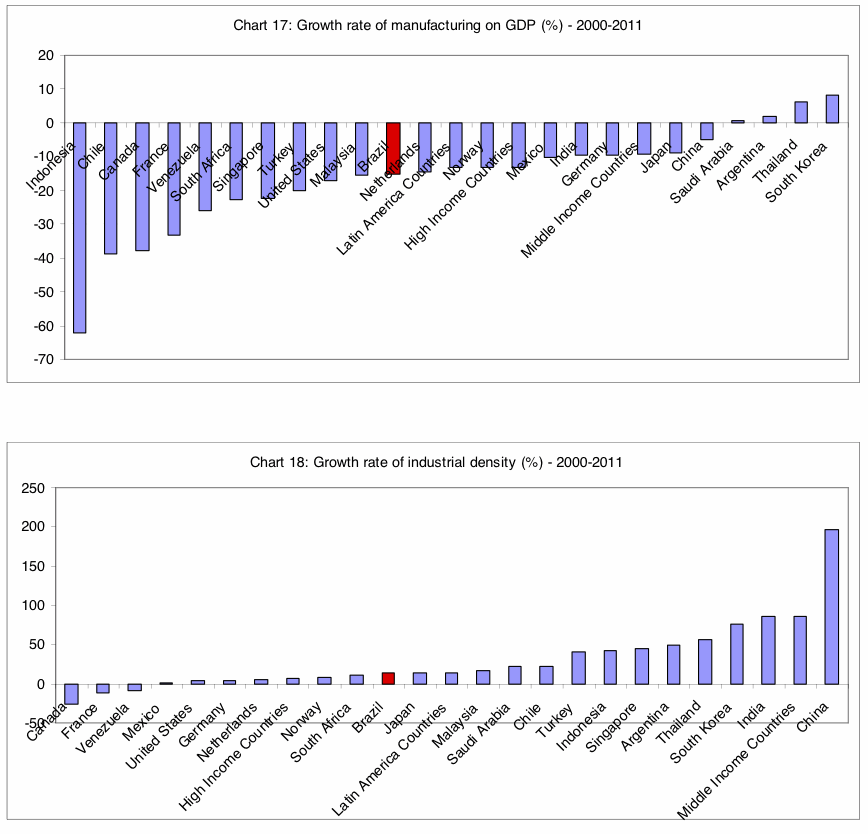
Brazil Graph of the Day (Ref. Manufacturing)


That is from the new working paper by Arbache, "Is Brazilian Manufacturing Losing its Drive?" (September 2012). The paper has other interesting graphs comparing different measures of manufacturing growth in different countries. I was surprised to see the majority of countries in the sample with negative growth in the 2000-2011 period, with the exceptions of Saudi Arabia, Argentina, Thailand, and South Korea. At least I thought that Mexico would have a positive rate, but I guess this suggest the large effect that the financial crisis has had around the world. 
 
Arbache's paper focuses on showing the reduction in the manufacturing sector in Brazil and on the policies to invigorate it. 
The position of the US in the graphs above is telling. For a good discussion on the US manufacturing sector see this recent post in Marginal Revolution.